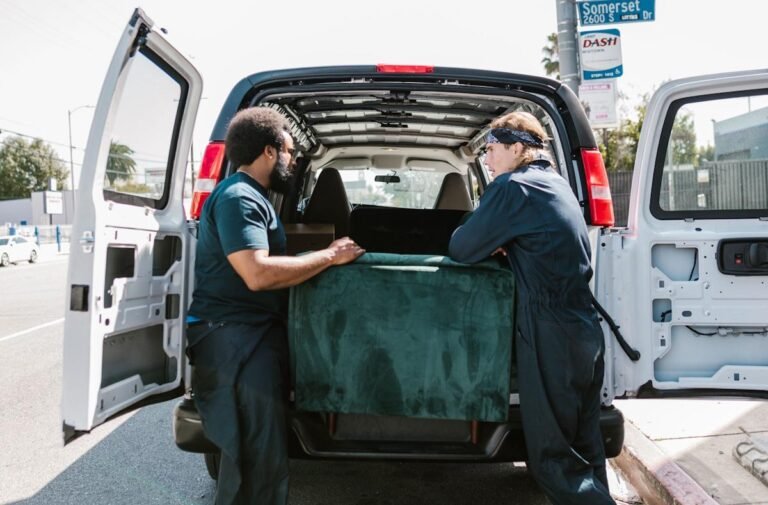
Choosing the right removal van can be surprisingly difficult. Book one that is too small and you may need an expensive second journey. Choose one that is unnecessarily large and you could pay more while making parking and access harder.
The honest answer is that you cannot select a van based only on the number of bedrooms in your home. A lightly furnished two-bedroom flat may fit into a large panel van, while a cluttered one-bedroom flat could require a Luton van. The right choice depends on what you are actually taking, how efficiently it is packed and how much the load weighs.
Here is how to work it out without relying on guesswork.
Start with a room-by-room inventory
Before comparing removal van sizes, walk through your home and record everything that needs to move.
Create four categories for each room:
- Packed boxes
- Furniture and appliances
- Fragile or unusually shaped items
- Items that will not be moving
Record large objects individually, including beds, wardrobes, sofas, tables, white goods, bicycles and garden furniture. Note whether each piece can be dismantled and measure its approximate length, width and height after dismantling.
Do not forget the loft, garage, shed, balcony, under-stairs cupboard or items stored outside. These overlooked areas are often the reason a carefully chosen van turns out to be too small.
At this stage, your inventory does not need to be perfect. Its purpose is to reveal the true scale of the move.
Declutter before you calculate the space
There is no point paying to transport things you plan to throw away after moving.
Sort unwanted belongings into four groups:
- Sell
- Donate
- Recycle
- Dispose of responsibly
Give yourself a deadline for selling items. If something has not sold by then, decide whether to donate it or take it with you. Avoid filling boxes with “maybe” items simply because making a decision feels difficult.
Start with duplicates, clothes you no longer wear, expired products, broken appliances and furniture that will not fit the new property. Decluttering reduces the number of boxes, the loading time and potentially the size of the van you need.
If a private company removes unwanted furniture or rubbish, check that it is authorised to carry waste. UK householders have a duty to take reasonable steps to ensure their waste is transferred to an authorised person. Registration can be checked through the Environment Agency’s public register.
Pack before making the final estimate
An unpacked room is difficult to measure accurately. Loose objects take up far more space than securely packed boxes, so pack as much as possible before confirming the vehicle.
Use boxes of reasonably consistent sizes. This makes them easier to stack and lets you estimate their total volume.
To calculate the volume of a box, multiply:
Length × width × height in metres
For example, a box measuring 40cm × 40cm × 40cm occupies approximately 0.064 cubic metres. Thirty boxes of that size would occupy around 1.92 cubic metres before allowing for gaps.
For furniture, use the widest measurements after any removable legs, shelves or panels have been taken off. You can also group packed belongings in one room, measure the floor space they occupy and multiply it by the height of the stack.
Allow approximately 15-20% additional space for irregular furniture, protective blankets and gaps that cannot be used efficiently. A van is never packed like a perfectly organised cube.
A quick guide to removal van sizes
Van categories are not completely standardised. Two companies may use the term “large van” for vehicles with different dimensions and payloads. Always ask for the actual load volume and internal dimensions of the vehicle being offered.
As a general guide, current UK fleets commonly range from approximately 2.3-3.7m³ for small vans, 5-6.5m³ for medium vans, 11-14m³ for large and extra-large panel vans, and around 17-19m³ for Luton vans. Exact specifications vary by model and configuration. Not sure which vehicle is right for your move? Changing Keys offers a complete range of removal van sizes and can recommend the best option based on your belongings, property access and travel distance.
When a small van is enough
A small van is generally suitable for:
- A student move
- Several boxes and suitcases
- The contents of one small room
- Collecting or delivering one piece of furniture
- A move with no large appliances or bulky furniture
A small van typically holds around 2-4m³. It may accommodate approximately a dozen medium boxes plus one or two small pieces of furniture, depending on their shape.
Do not choose a small van for a normally furnished flat simply because the journey is short. Distance does not reduce the amount of space your possessions occupy.
When to choose a medium van
A medium van usually provides around 5-7m³ of load space. It can be suitable for:
- A lightly furnished studio
- The contents of one larger room
- A student move with some furniture
- Around 20-25 boxes plus several compact items
- A dismantled bed, small sofa and limited additional furniture
Measure long items carefully. A sofa or mattress may fit within the van’s total volume but still be too long or wide to pass through the doors or lie safely inside.
If you are moving a bed, sofa, appliances and a full collection of boxes together, a large van is usually the safer option.
When you need a large van
Large and extra-large panel vans generally offer around 10-14m³. They are often appropriate for:
- A furnished one-bedroom flat
- A lightly furnished two-bedroom property
- Approximately 40-60 medium boxes
- Several large pieces of furniture
- Long items that will not fit into a medium van
A large van is also sensible when the properties are far apart and a second journey would be impractical. However, a heavily furnished two-bedroom home may still exceed its capacity.
Send the removals company a complete inventory rather than relying on the phrase “two-bedroom flat”. The number of possessions matters more than the number of rooms.
When a Luton van is the better choice
A Luton van has a box-shaped body, additional space above the cab and often a tail lift. Typical load volume is around 17-19m³.
It is a strong option for:
- A fully furnished two-bedroom home
- Some moderately furnished three-bedroom properties
- Large sofas, wardrobes and dining furniture
- Multiple appliances
- Approximately 60-70 medium boxes
- Heavy items that are easier to load with a tail lift
A Luton van is spacious, but it is not automatically sufficient for every three-bedroom house. A heavily furnished family home, large garden, garage contents or extensive storage may require more than one vehicle or a larger lorry.
Remember that weight matters too
Cubic capacity is only half of the calculation. Every van also has a maximum permitted loaded weight.
Books, records, tools, gym equipment, filing cabinets, stone furniture and large plant pots can reach the payload limit before the van appears full. The vehicle’s design gross weight includes the van itself, fuel, driver, passengers and everything being transported. Overloading affects safety and can result in penalties.
Tell the removal company about unusually heavy items rather than describing them simply as boxes.
Pack efficiently without making boxes unsafe
Efficient packing can reduce wasted space, but it should never make boxes too heavy to lift.
- Put books and other dense objects in small boxes.
- Use larger boxes for bedding, cushions and lightweight items.
- Dismantle furniture where practical and keep fittings in labelled bags.
- Fill empty spaces inside boxes so items cannot move.
- Use similar-sized boxes that can be stacked securely.
- Protect furniture with blankets rather than relying on loose plastic bags.
- Keep essentials, documents and chargers separate and load them last.
- If self-loading, distribute heavy items evenly and secure the load with appropriate straps.
A professional removals team should handle the final loading order and weight distribution.
Consider parking and property access
The largest van is not always the most practical one.
Check whether the vehicle can reach both properties. Consider narrow streets, low entrances, height restrictions, parking controls and the distance between the van and the front door. Flats may also have lift restrictions or designated moving times.
Send photographs of entrances, staircases and parking areas to the removals company. A slightly smaller vehicle with easier access may complete the job faster than a Luton parked far down the road.
Ask for a professional assessment
Once your inventory is ready, send the removals company:
- The number and approximate size of your boxes
- A list of furniture and appliances
- Measurements of unusually large items
- Details of stairs, lifts and parking
- Photographs or a short video of the contents
Ask whether the recommended vehicle can complete the move in one journey, how many movers are included and whether dismantling or reassembly is required.
Still wondering, “What size removal van do I need?” Changing Keys can assess your inventory, access and travel distance before recommending the most suitable vehicle. A few accurate details before moving day can prevent delays, extra journeys and unnecessary costs.